17/2026-03
Hong Kong Web3 Major Boost: First Stablecoin Licenses to Be Officially Issued in March - Who Can Seize the First Wave of Compliance Dividends?
According to Reuters, Hong Kong's financial regulatory authority (HKMA) is set to approve the first batch of stablecoin issuer licenses in March.
This development marks a critical step in the compliance narrative, following a lengthy regulatory review period and the implementation of the world's most comprehensive (most robust) stablecoin framework, which officially took effect last August.
At a Legislative Council meeting on Monday, HKMA Chief Executive Eddie Yue revealed that the review process has entered its final stage. However, he also made it clear that for the sake of prudence, the number of first-time approved applicants will be very limited.
Yue added that the current assessment focus covers several core dimensions: specific implementation scenarios (narratives) for stablecoins, reserve collateralization of underlying assets, risk control systems, and anti-money laundering (AML) compliance reviews.
Hong Kong's Stablecoin Era "Difficult Birth"? Regulatory Thresholds Maxed Out, First Batch of Licensing at Extremely Slow Pace
As of early February, under Hong Kong's new regulatory framework, no stablecoin issuer has successfully "obtained a license" yet.
The Hong Kong Monetary Authority (HKMA) revealed that it is currently conducting an in-depth "screening" of the first batch of 36 applying institutions. Although industry enthusiasm was previously high, with over 40 potential applicants emerging at one point, the actual list entering the review has shrunk.
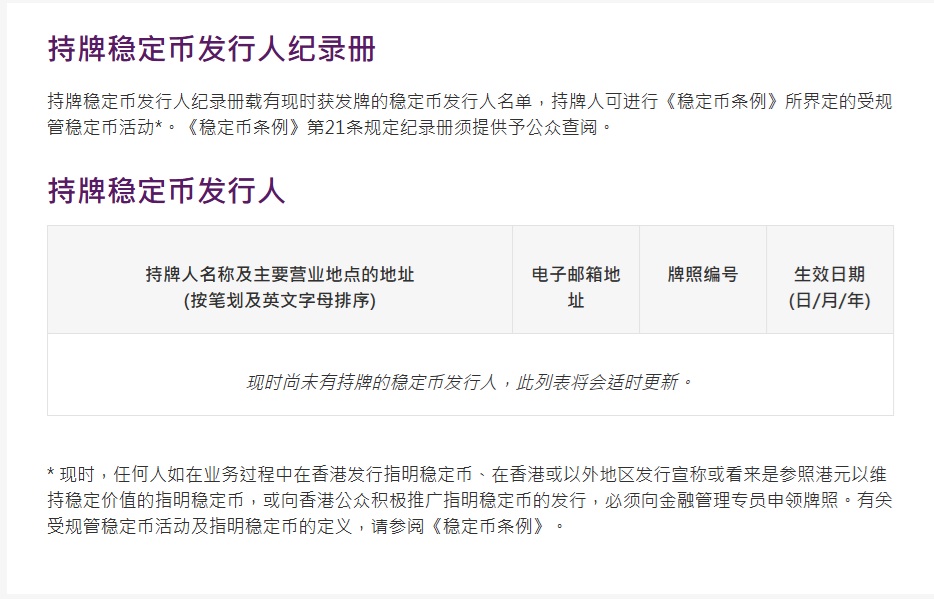
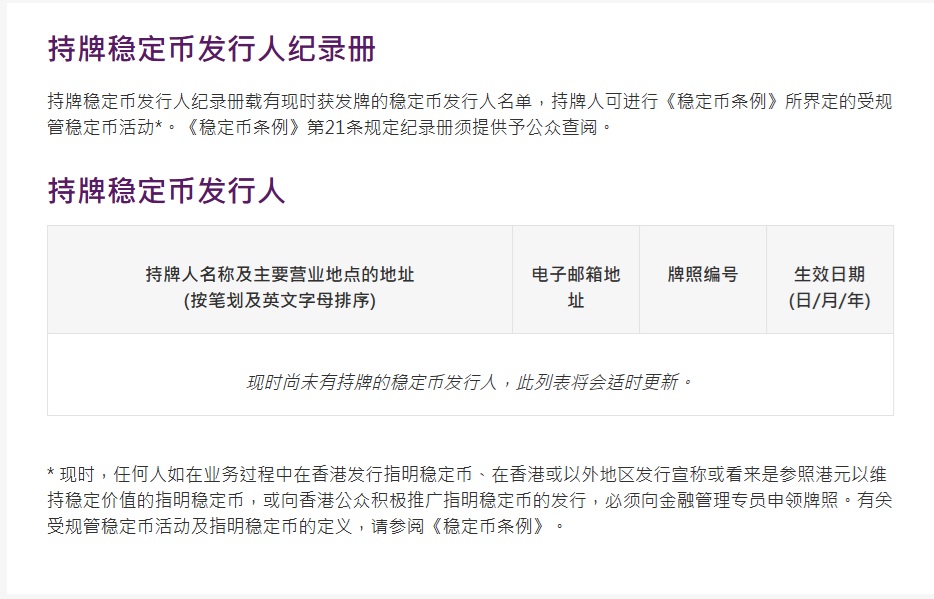
Regulators have maintained extreme caution to date. Although a "whitelist" (public register) specifically for disclosing licensed issuers was introduced as early as July 2025, embarrassingly, the directory remains in a "blank state" with no institutions having successfully passed through.
Source: Hong Kong Monetary Authority - Record of Licensed Stablecoin Issuers
The licensing system implemented last August covers all fiat-backed stablecoin issuers in Hong Kong, as well as overseas token issuers pegged to the Hong Kong dollar.
According to regulations, licensed institutions have the right to issue, manage, and redeem stablecoins, provided they must provide 1:1 full reserve support through approved custodial arrangements using high-quality, liquid assets.
Issuers must fulfill redemption requests at par value within one business day and are strictly prohibited from paying interest to stablecoin holders.
The system also places high emphasis on corporate governance and compliance. According to the rules, issuers must be locally registered companies or authorized institutions, with comprehensive internal control mechanisms, and their boards must include independent directors with specific compliance functions.
Additionally, issuers must conduct customer due diligence (KYC), regulate wallet usage, and strictly comply with anti-money laundering (AML) and anti-terrorist financing requirements.
The Hong Kong Monetary Authority (HKMA) possesses extensive regulatory powers, including adding additional conditions to licenses, appointing administrators to take over, or directly revoking licenses in cases of non-compliance.
This development marks a critical step in the compliance narrative, following a lengthy regulatory review period and the implementation of the world's most comprehensive (most robust) stablecoin framework, which officially took effect last August.
At a Legislative Council meeting on Monday, HKMA Chief Executive Eddie Yue revealed that the review process has entered its final stage. However, he also made it clear that for the sake of prudence, the number of first-time approved applicants will be very limited.
Yue added that the current assessment focus covers several core dimensions: specific implementation scenarios (narratives) for stablecoins, reserve collateralization of underlying assets, risk control systems, and anti-money laundering (AML) compliance reviews.
Hong Kong's Stablecoin Era "Difficult Birth"? Regulatory Thresholds Maxed Out, First Batch of Licensing at Extremely Slow Pace
As of early February, under Hong Kong's new regulatory framework, no stablecoin issuer has successfully "obtained a license" yet.
The Hong Kong Monetary Authority (HKMA) revealed that it is currently conducting an in-depth "screening" of the first batch of 36 applying institutions. Although industry enthusiasm was previously high, with over 40 potential applicants emerging at one point, the actual list entering the review has shrunk.
Regulators have maintained extreme caution to date. Although a "whitelist" (public register) specifically for disclosing licensed issuers was introduced as early as July 2025, embarrassingly, the directory remains in a "blank state" with no institutions having successfully passed through.
Source: Hong Kong Monetary Authority - Record of Licensed Stablecoin Issuers
The licensing system implemented last August covers all fiat-backed stablecoin issuers in Hong Kong, as well as overseas token issuers pegged to the Hong Kong dollar.
According to regulations, licensed institutions have the right to issue, manage, and redeem stablecoins, provided they must provide 1:1 full reserve support through approved custodial arrangements using high-quality, liquid assets.
Issuers must fulfill redemption requests at par value within one business day and are strictly prohibited from paying interest to stablecoin holders.
The system also places high emphasis on corporate governance and compliance. According to the rules, issuers must be locally registered companies or authorized institutions, with comprehensive internal control mechanisms, and their boards must include independent directors with specific compliance functions.
Additionally, issuers must conduct customer due diligence (KYC), regulate wallet usage, and strictly comply with anti-money laundering (AML) and anti-terrorist financing requirements.
The Hong Kong Monetary Authority (HKMA) possesses extensive regulatory powers, including adding additional conditions to licenses, appointing administrators to take over, or directly revoking licenses in cases of non-compliance.