25/2026-03
Bitcoin Unexpectedly Becomes a 'Safe Haven' Amid the Impact of the Iran War on the Market
Article source: Cailian Press
Since the outbreak of the Iran war, cryptocurrencies have stood out among various assets and become one of the winners. However, the resilience of digital assets may be largely attributed to the factor of timing.
Compared with the sharp fluctuations of stocks, etc., Bitcoin (the cryptocurrency with the largest market value) and a group of small - and medium - sized digital assets have shown relatively stable performance in recent times.
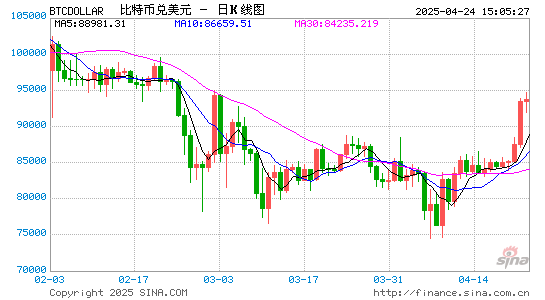
Specifically, the crude oil price has risen by more than 40%, gold has fallen by about 5% this month, and the MSCI Global Index has dropped by 4%. Bitcoin once broke through the $75,000 mark on Tuesday, with a cumulative increase of nearly 14% since the war broke out at the end of February.
This is in sharp contrast to the sharp crash in October last year. At that time, Bitcoin reached a record high of $126,000, but then experienced months of selling, and its price was once halved.
However, as cryptocurrency traders have flocked back to exchange - traded funds (ETFs), the rebound momentum of Bitcoin has accelerated amid the turmoil in the global financial markets triggered by the war.
Rachael Lucas, an analyst at the cryptocurrency trading platform BTC Markets, said: "The current resilience of Bitcoin is more due to market mechanisms than narratives. Institutional buyers, especially corporate funds, are buying in large quantities on each pullback."
Data shows that spot Bitcoin ETFs traded in the United States this month have attracted about $1.5 billion in capital inflows.
Markus Thielen, the research director of 10x Research, pointed out that the recent bullish signals in the cryptocurrency market are partly due to traders closing out their option positions that were previously betting on Bitcoin falling below the range of $55,000 to $60,000. As these bearish positions are closed, the price of Bitcoin has risen accordingly.
He wrote in a report: "The selling or closing of Bitcoin put options reduces the downward hedging pressure and forces market - makers to buy Bitcoin to re - balance their exposures, thus creating a capital flow that drives up the price."
According to data from the derivatives trading platform Deribit, about $1.5 billion worth of Bitcoin put options are concentrated around $60,000, while there are $1.3 billion worth of call options around $75,000.
After the United States and Israel launched an air strike on Iran on February 28, Bitcoin briefly tumbled, hitting a low of $63,000. Hayden Hughes, the managing partner of Tokenize Capital, pointed out that the subsequent rebound "is supported by real positions".
He said: "The recovery initially supported by structural factors has turned into momentum trading, and investors with early - holding advantages have begun to take profits."
Currently, Bitcoin still maintains upward momentum, and its perpetual futures funding rate is positive, which means that traders holding long positions need to pay fees to short - sellers. In addition, the Bitcoin premium on ___IMG_0___ also shows strong demand in the US market. Strategy (MicroStrategy), which focuses on buying and holding Bitcoin, has also increased its position in this cryptocurrency recently.
However, Thielen warned that this round of rally has not been accompanied by obvious call - option buying, indicating that the previous upward trend was more driven by hedge - position closing rather than aggressive bullish layouts.
Hughes of Tokenize Capital believes that this round of rally may reverse soon. He said that although Bitcoin may reach $80,000 in the short term, the upward trend may weaken next month and may decline further in August.
Since the outbreak of the Iran war, cryptocurrencies have stood out among various assets and become one of the winners. However, the resilience of digital assets may be largely attributed to the factor of timing.
Compared with the sharp fluctuations of stocks, etc., Bitcoin (the cryptocurrency with the largest market value) and a group of small - and medium - sized digital assets have shown relatively stable performance in recent times.
Specifically, the crude oil price has risen by more than 40%, gold has fallen by about 5% this month, and the MSCI Global Index has dropped by 4%. Bitcoin once broke through the $75,000 mark on Tuesday, with a cumulative increase of nearly 14% since the war broke out at the end of February.
This is in sharp contrast to the sharp crash in October last year. At that time, Bitcoin reached a record high of $126,000, but then experienced months of selling, and its price was once halved.
However, as cryptocurrency traders have flocked back to exchange - traded funds (ETFs), the rebound momentum of Bitcoin has accelerated amid the turmoil in the global financial markets triggered by the war.
Rachael Lucas, an analyst at the cryptocurrency trading platform BTC Markets, said: "The current resilience of Bitcoin is more due to market mechanisms than narratives. Institutional buyers, especially corporate funds, are buying in large quantities on each pullback."
Data shows that spot Bitcoin ETFs traded in the United States this month have attracted about $1.5 billion in capital inflows.
Markus Thielen, the research director of 10x Research, pointed out that the recent bullish signals in the cryptocurrency market are partly due to traders closing out their option positions that were previously betting on Bitcoin falling below the range of $55,000 to $60,000. As these bearish positions are closed, the price of Bitcoin has risen accordingly.
He wrote in a report: "The selling or closing of Bitcoin put options reduces the downward hedging pressure and forces market - makers to buy Bitcoin to re - balance their exposures, thus creating a capital flow that drives up the price."
According to data from the derivatives trading platform Deribit, about $1.5 billion worth of Bitcoin put options are concentrated around $60,000, while there are $1.3 billion worth of call options around $75,000.
After the United States and Israel launched an air strike on Iran on February 28, Bitcoin briefly tumbled, hitting a low of $63,000. Hayden Hughes, the managing partner of Tokenize Capital, pointed out that the subsequent rebound "is supported by real positions".
He said: "The recovery initially supported by structural factors has turned into momentum trading, and investors with early - holding advantages have begun to take profits."
Currently, Bitcoin still maintains upward momentum, and its perpetual futures funding rate is positive, which means that traders holding long positions need to pay fees to short - sellers. In addition, the Bitcoin premium on ___IMG_0___ also shows strong demand in the US market. Strategy (MicroStrategy), which focuses on buying and holding Bitcoin, has also increased its position in this cryptocurrency recently.
However, Thielen warned that this round of rally has not been accompanied by obvious call - option buying, indicating that the previous upward trend was more driven by hedge - position closing rather than aggressive bullish layouts.
Hughes of Tokenize Capital believes that this round of rally may reverse soon. He said that although Bitcoin may reach $80,000 in the short term, the upward trend may weaken next month and may decline further in August.